
Therapist Professional Development: 5 Ways to Boost Your Career

Article Summary: You can advance your career as a therapist on your own terms! Some of our favorite therapist professional development options are therapist CE retreats, podcasts, local seminars, online webinars, and finding a mentor.
Being a therapist is a tough job. Between a steady stream of patients and administrative work, you’re tasked with balancing unique client challenges with endless recordkeeping—responsibilities that are challenging for even the best practitioners.
But by exploring professional development opportunities, you can sharpen your skills, enhance your productivity, and get ahead of the competition.
And that’s a good thing. The American Counseling Association expects the U.S. behavioral health market to reach $136 billion by 2032, which means you should do everything you can to solidify your client base right now.
Remember: It’s never too late to start working on yourself.
For help, pick up some of our favorite tactics for advancing your career. Use the table of contents or continue reading to learn more.
Table of Contents
5 Therapist Development Tactics That Will Elevate Your Career
- Attend A Therapist CE Retreat
- Listen to Therapist Podcasts
- Attend A Local College Course or Seminar
- Attend Online Webinars
- Find A Mentor
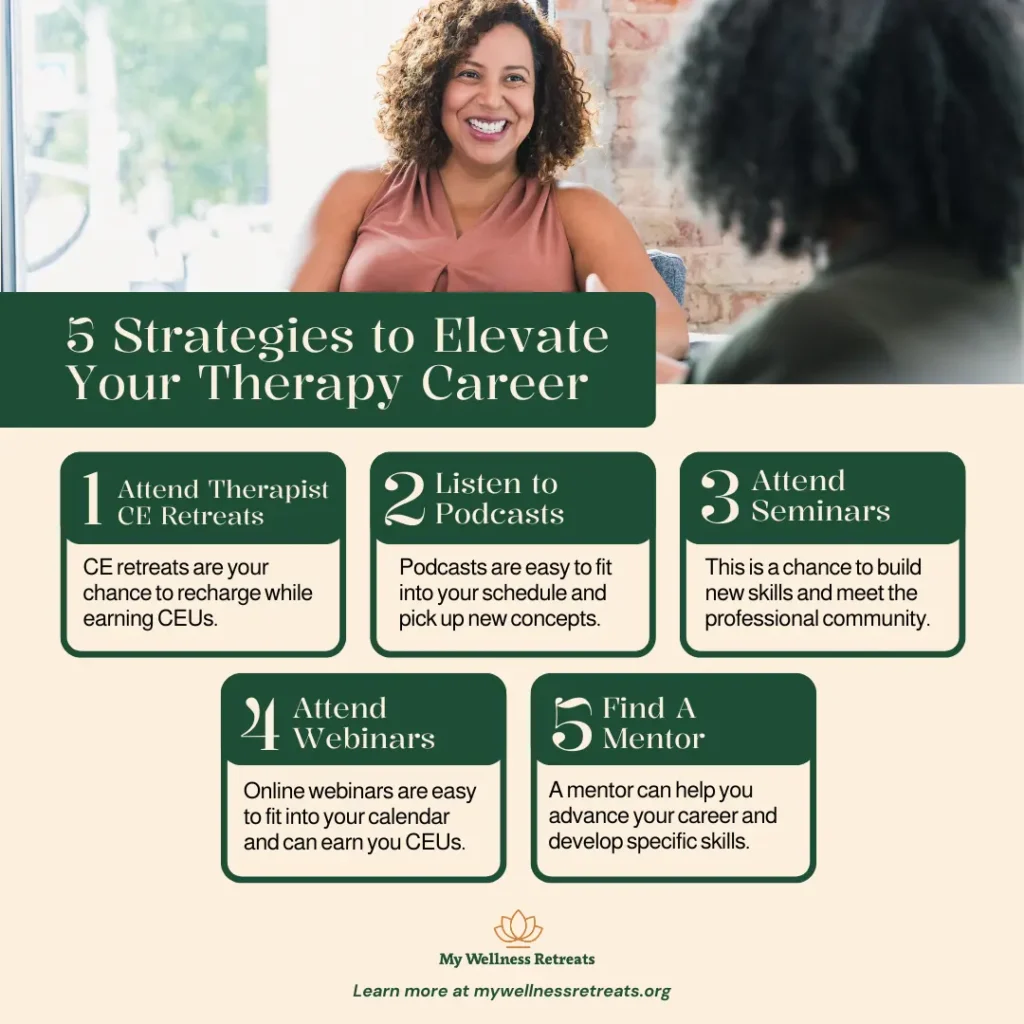
5 Therapist Development Tactics That Will Elevate Your Career
Here are five avenues to explore for therapist professional development:
1. Attend A Therapist CE Retreat
A therapist CE retreat offers the ideal blend of professional development courses and downtime to help you relax—leaving you feeling refreshed and rejuvenated to apply your new skills in future therapy sessions.
Bonus: These retreats will also connect you with fellow growth-focused professionals who can further assist you on your journey to becoming a better therapist.
In 2026 & 2027 Retreats For Therapists: Mark Your Calendar For Growth, we outlined some of our favorite resources for finding your next therapist retreat, including:
1. My Wellness Retreats
Founded by My Wellness Center owner Tomi Ward, LPC, MPC, NCC, My Wellness Retreats was created by therapists for therapists.
Here, we focus on offering forward-thinking curricula in beautiful locations—getting you out of the office grind and into a growth-focused mindset.
At My Wellness Retreats, you’ll connect with like-minded therapists from around the country so you can expand your network and develop deep, long-lasting relationships with your peers.
Two of our upcoming retreat options:
- March 7–March 14: Costa Rica, The Goddess Garden – Earn up to 18 CE credits while diving deep into topics like post-traumatic resilience, somatic practices for post-traumatic growth, the 8 C’s of self energy, tools for self-care, and more. Plus, you’ll enjoy nutritious meals, daily yoga, and exploration opportunities. Register today!
- April 12–April 17 (2027): Panama, Selva Terra – Earn up to 15 CE credits in a hidden sanctuary nestled along the Gulf of Chiriqui and bordering the pristine rainforest. Dive into topics like resilience & renewal, substance use in the perinatal journey, and birth trauma. Register today!
- June 22–25 (2027): Ireland – Spend a beautiful, luxurious week at the historic Kilkea Castle. Register today!
- July 1–July 7 (2027): Greece – Details are coming!
We also offer discounted packages for family and friends who are simply interested in an opportunity to get away! While they can’t attend the CE sessions, they can enjoy everything else the venue has to offer!
Tip: Never miss an announcement for our upcoming offers or retreats. Subscribe to our newsletter today!
2. American Psychological Association
No surprises here: The American Psychological Association (APA) is one of the most trusted sources for continuing education in the mental health field.
Their CE offerings are designed to meet high academic standards, featuring up-to-date, research-based material in areas such as trauma, ethics, treatment modalities, cultural competence, and more.
APA CEUs are widely accepted by licensing boards across the United States, making them a convenient and reputable choice for professionals from all corners of the field—and especially good for therapists.
Another major bonus: APA is very flexible in its learning formats. You can earn CE credits through:
- on-demand video courses
- webinars
- book-based exams
- journal article quizzes
Many offerings are self-paced, which makes APA ideal for busy clinicians juggling full caseloads.
3. PESI
PESI (formerly Professional Education Systems Institute) is a powerhouse in the continuing education world, and it’s known for its comprehensive course offerings and wide accessibility.
Although PESI serves psychologists, counselors, social workers, marriage and family therapists, and other mental health professionals, PESI is especially popular among therapists looking for practical, skills-based trainings that they can apply directly to client sessions.
Like the APA, PESI’s catalog spans live and on-demand webinars, multi-day intensives, certification programs, and digital downloads. Topics range from trauma treatment and EMDR to somatic therapies, ethics, ADHD, and cultural competency.
Their courses are approved by nearly all state licensing boards and national organizations. PESI’s in-person workshops are also popular, especially among clinicians who prefer hands-on learning and networking opportunities.
4. National Association of Social Workers
The National Association of Social Workers (NASW) offers continuing education that reflects the diverse realities social workers face in the field. From micro-level clinical work to macro-level policy advocacy, NASW’s CEU programs are built to support social workers across all practice areas.
Like others on this list, NASW provides both live virtual trainings and on-demand courses across a wide range of topics:
- mental health treatment
- diversity and inclusion
- ethics
- substance use
- healthcare systems
- family dynamics
The NASW also hosts state-specific CE events that are especially helpful for those navigating local licensure requirements or working within regional communities. Courses typically include quizzes or knowledge checks to ensure engagement, and completion certificates are easily downloadable for submission to state boards.
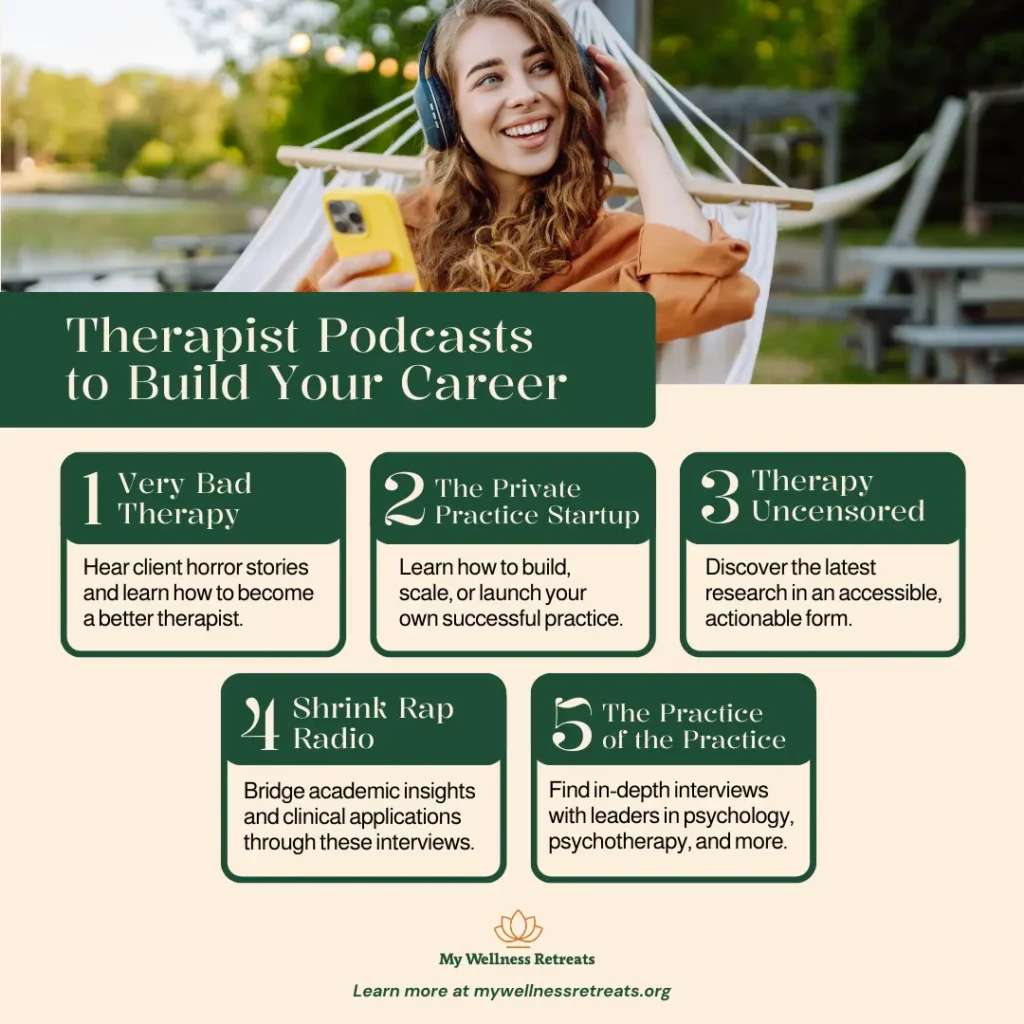
2. Listen to Therapist Podcasts
Podcasts can be a terrific option for therapists on the go. Pop on an episode during your morning commute or while you’re on the stairmaster at the gym. You can work on your therapy professional development whenever it suits your schedule!
Here are some of the most popular shows in the therapy/mental health profession:
1. Very Bad Therapy
About: This is a favorite around the office at My Wellness Center (our sister company)! Very Bad Therapy offers a candid look at what goes wrong in the counseling room—from the clients’ perspectives—and how therapy could be done better.
Hosted by Ben Fineman and Caroline Wiita, the show features real stories and critiques of therapeutic practice, giving therapists thoughtful insight into client experiences, ethical pitfalls, and recovery‑oriented care.
It’s a smart listen for any clinician committed to improving their practice and deepening empathic understanding.
Listen: Visit the Very Bad Therapy Website
2. The Private Practice Startup
About: The Private Practice Startup podcast supports therapists who want to build, scale, or launch their own private practice.
With 300+ episodes, it covers business strategy, marketing, forms, compliance, client acquisition, and culture for mental‑health professionals.
If you’re juggling therapy and business, this podcast gives you tangible tools and inspiration for managing both your clinician identity and your business goals.
Listen: Visit the Private Practice Startup Website
3. Therapy Uncensored
About: Therapist Uncensored is a female‑led, science‑backed podcast co‑hosted by Sue Marriott, LCSW‑CGP and Ann Kelley, PhD.
With over 11 million downloads and an Apple “Top 10 Social Science” ranking, it brings complex relational and attachment‑science research into an accessible, actionable form.
Episodes explore what makes us tick personally and professionally—ideal for therapists looking to sharpen clinical thinking and deepen relational skills.
Listen: Visit the Therapy Uncensored Website
4. Shrink Rap Radio
About: Shrink Rap Radio, hosted by Dr. David Van Nuys, features in‑depth interviews with leading figures in psychology, psychotherapy, consciousness, and personal growth.
Since 2005, it has explored brain, body, mind, spirit, leadership, and research in a format that bridges academic insight and clinical application.
Therapists benefit from its strong intellectual foundation and broad subject matter—perfect for reflective professionals seeking intellectual stimulation.
Listen: Visit the Shrink Rap Radio Website
5. The Practice of the Practice Podcast
About: The Practice of the Practice Podcast, hosted by Joe Sanok, is crafted for therapists, counselors, coaches, and wellness professionals who want to grow their practice and move beyond client work alone.
Covering topics from private‑practice strategy to the future of mental health care, it merges modern psychology with practice‑building insight. If you’re ready to leverage your clinical skills into a thriving practice, this podcast is a go‑to resource.
Listen: Visit the Practice of the Practice Website
3. Attend A Local College Course or Seminar
If you’re looking for in-person learning opportunities that complement your clinical work, attending a local college course or community seminar can be a great option.
Many universities and continuing education centers offer workshops, certificate programs, or non-credit courses that are open to working professionals.
These settings often bring together a diverse group of attendees—including educators, healthcare workers, and nonprofit leaders—which can enrich your understanding of mental health issues across different communities.
Courses may focus on specialized topics like trauma-informed care, motivational interviewing, play therapy, or cultural humility. Others might explore broader areas like leadership in healthcare, grant writing for mental health programs, or public speaking skills for clinicians.
To find relevant events in your area, check local universities, community mental health organizations, or hospital education departments.
Ongoing education can be incredibly beneficial. Here’s how My Wellness Retreats speaker Andra Bruce, LSCW, puts it: “The one thing our brains never tire of is learning. I love learning new therapies and improving my skills. I find this keeps my work fresh and gives me confidence in the tools I have to offer clients.”
4. Attend Online Webinars
Not every therapist has the flexibility to leave town for a weeklong retreat—and that’s okay. Thankfully, there are plenty of reputable organizations offering virtual CE trainings, live webinars, and on-demand courses that let you learn from the comfort of your own space.
Here are a few standout options worth exploring if you’re interested in advancing your career or exploring professional development opportunities:
1. American Psychological Association (APA)
As we mentioned earlier, the APA offers a robust selection of online continuing education opportunities—ranging from self-paced eLearning modules to live webinars and journal-based courses. New content is added regularly, covering everything from trauma-informed care to ethics, cultural competency, and emerging treatment modalities.
APA members get discounted access and exclusive bundles, but non-members can still browse many valuable trainings—and in some cases, even access free content. Whether you’re looking for formal CEUs or just want to stay sharp, APA’s educational hub is both respected and flexible.
2. PESI
PESI is one of the largest providers of continuing education for mental health professionals, offering hundreds of trainings across multiple specialties. You’ll find a mix of live webcasts, replays, and downloadable content on topics like EMDR, somatic work, grief, trauma, perinatal mental health, and more.
While most content is behind a paywall, PESI often runs promotions and bundles that make it cost-effective—especially if you’re planning to complete several CEUs in one go. Many of their instructors are nationally recognized leaders in the field.
3. National Association of Social Workers (NASW)
The NASW provides accessible online learning options specifically geared toward social workers—but clinicians of all stripes can benefit from their curriculum. Their Virtual Learning Platform includes courses on mental health, racial equity, LGBTQIA2S+ advocacy, family systems, and policy reform.
Some offerings are free to members, and many are approved for CE credit across multiple states. If you’re working in social work or community mental health, NASW is a mission-driven provider worth bookmarking.
4. My Wellness Center
As a therapist-led practice based in Pittsburgh, My Wellness Center (our sister company) offers webinars designed to blend clinical depth with real-world application. Their virtual training series has covered topics like maternal mental health, perinatal substance use, and self-care for therapists.
Frequent presenters include Tomi Ward, LPC, MPC, NCC (founder of My Wellness Center and My Wellness Retreats) and Associate Counselor Kelly O’Connell. These sessions tend to be intimate, grounded, and focused on areas often overlooked in larger CE platforms—especially those relevant to family care, parenting, and burnout recovery.
5. Find A Mentor
Mentorship can be one of the most powerful catalysts for professional growth—especially in a field as emotionally demanding as therapy. A trusted mentor offers more than just career advice. They can provide perspective on difficult clinical cases, help you navigate ethical dilemmas, offer encouragement through burnout, and connect you to other valuable resources in the field.
Your mentor doesn’t have to be someone older or from a traditional supervisory background. They could be a peer who’s advanced in a specific specialty you want to learn more about, or someone who has successfully launched their own private practice. The key is finding someone who listens well, gives honest feedback, and models the kind of therapist or professional you aspire to be.
To find a mentor, consider reaching out to colleagues at your workplace, former professors, or leaders in professional organizations. Participating in local CE events or online groups (like therapist Facebook groups or ACA/NASW forums) can also introduce you to experienced professionals open to mentorship relationships.
Remember: You don’t have to navigate your career alone.
Frequently Asked Questions
How many professional development hours or CEUs do I need per year?
The number of CEUs required each year depends on your state licensure board and your specific license type (e.g., LPC, LCSW, LMFT, etc.).
In most states, the requirement falls between 20–40 hours every 1–2 years. Some boards require specific content areas, so it’s important to check with your state licensing agency for exact guidelines.
Do CEUs from retreats or podcasts actually count toward licensure requirements?
CEUs from retreats will count only if the retreat provider is approved by your licensing board. Always verify that the course or retreat offers board-approved credits before enrolling.
Podcasts, on the other hand, typically do not count for CE credit—unless accompanied by a post-test or certificate from an approved provider. They’re great for informal learning, but not for licensure renewal.
Note: Our retreats at My Wellness Retreats are approved by the APA!
Can I carry CEUs over into the next licensing cycle?
It depends on your state and license. Some licensing boards allow you to roll over excess CEUs to your next renewal cycle, while others require all hours to be earned within a set timeframe.
Always confirm with your board before assuming rollover is permitted, and keep detailed records of completed CEUs and certificates.
About the Author: Tomilyn Ward, LPC, MPC, NCC
Tomilyn Ward, LPC, MPC, NCC is a trauma-informed therapist and the founder of My Wellness Retreats; My Wellness Center, a mental health practice based in Allison Park, PA, just outside of Pittsburgh; and the MAYA Organization, a nonprofit assisting low-income pregnant women in need of guidance. She’s also a birth doula who has assisted in more than 30 births. A lifelong learner, Tomilyn regularly takes three times the required number of CEU credits every year.
One Response