
Self Care for Therapists: 10 Tips for Better Health & Workplace Performance

Article Summary: Therapists all over the country complain about being overworked, underpaid, and burned out. Here are the best strategies behind self care for therapists: attend a therapist CE retreat, improve your diet, exercise, lean on your social circle, schedule self care, create professional boundaries, use micro-breaks, reduce screentime, find a creative outlet, and attend therapy.
As therapists, we spend all day helping people learn deep-seated truths about themselves and develop skills to improve their mental, physical, and emotional wellbeing.
Unfortunately, we don’t always apply those same principles to ourselves.
And that doesn’t make sense. Therapists frequently complain of being overworked, underpaid, and burned out—but we’re not taking measurable steps to improve that.
Let’s overcome that today with self care for therapists. In this article, we’ll explore quick, actionable steps you can take right now to boost your overall health.
Use the table of contents to get started.
Table of Contents
Mental Health Issues Among Therapists
10 Self Care Tips for Therapists
Frequently Asked Questions
Mental Health Issues Among Therapists
Mental health is a major issue among therapists and other professionals. Therapist burnout is rampant, and it impacts a therapist’s ability to treat patients.
Here’s the proof:
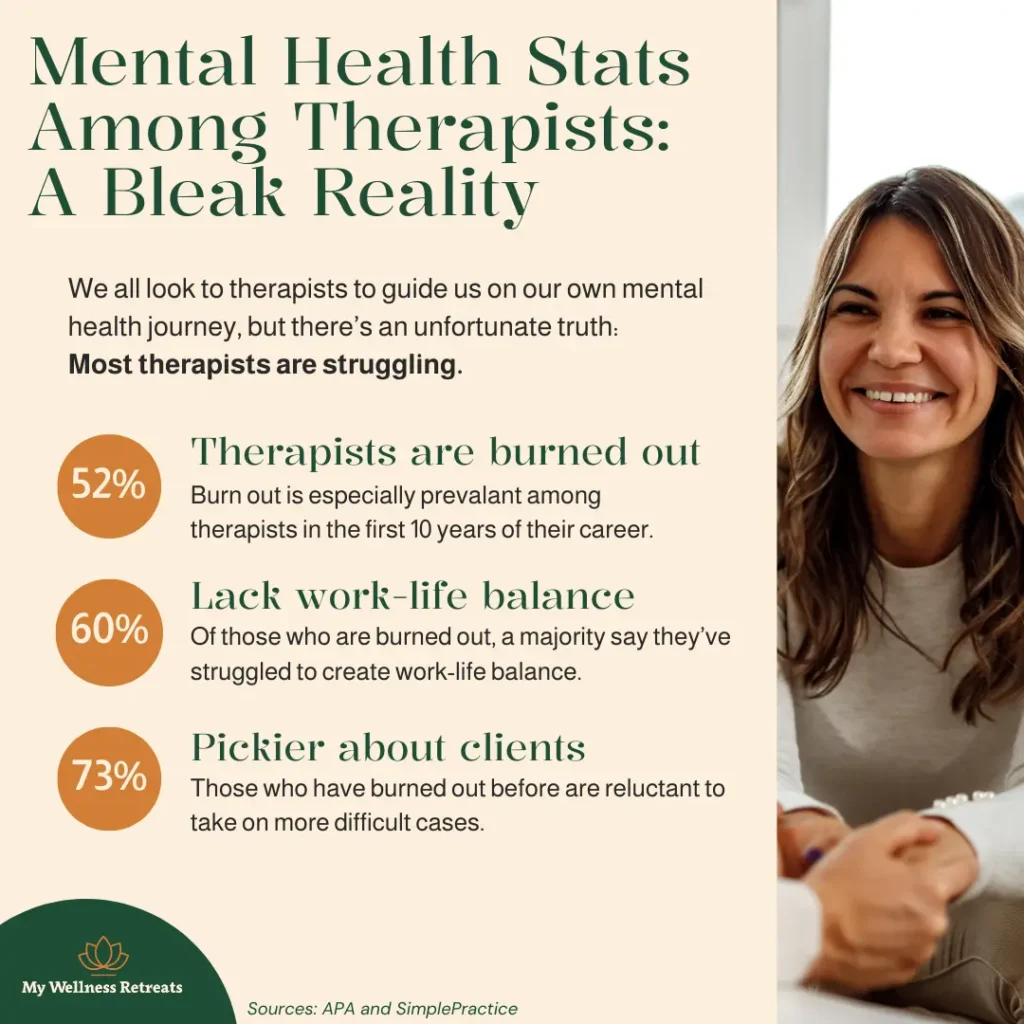
- Research from the American Psychological Association shows 57% of therapists in the first 10 years of their career are burned out. And it doesn’t get a lot better as you advance. Forty-seven percent of professionals 11–20 years into their career report feeling burned out.
- A 2023 survey by SimplePractice found 52% of therapists reported feeling burned out in the last year.
- Of those individuals, 73% said burnout made them hesitant to take on tougher clients, and 60% said their lack of work-life balance contributed to burnout.
And it’s a bad time to be burned out, as industry experts only expect demand for therapy to increase significantly over the next seven years. In fact, the American Counseling Association expects the U.S. behavioral health market to grow by $49 billion to reach $136 billion by 2032.
Being burned out has two negative professional outcomes:
- It hampers your ability to scale with demand. If you can’t take on more patients, you can’t grow your client base.
- It hampers your ability to increase your income as society places a greater emphasis on mental health care.
Related Reading: 5 Solutions to Therapist Burnout
10 Self Care Tips for Therapists
As professionals, we all know the value of self-care for caregivers. And we should apply that same principle to our own line of work.
And, look, we’ve heard all of the excuses:
- I’m too busy to take time off.
- I don’t have enough time to get to the gym.
- I have too many responsibilities outside of the office to take care of myself.
At the end of the day, these are just that—excuses. You know better than anyone else that self care is critical. Here’s how to start taking better care of yourself:
1. Take A Therapist CE Retreat
It’s probably no surprise that we love retreats. (Our company name is My Wellness Retreats, after all.) But there’s a reason we’re so passionate about therapist retreats: they’re powerful.
We know firsthand just how impactful it is to spend a few days with fellow growth-minded professionals as you focus on developing your skills, eating healthy meals, prioritizing self-care, and finding new, exciting extracurriculars.
Done well, a therapist CE retreat is a potent blend of vacation and therapist professional development that leaves you feeling refreshed, recharged, and ready to take on your client workload with gusto.

Here’s a look at our 2026 and 2027 retreats:
- March 7–March 14: Costa Rica, The Goddess Garden – Earn up to 18 CE credits while diving deep into topics like post-traumatic resilience, somatic practices for post-traumatic growth, the 8 C’s of self-energy, tools for self-care, and more. Plus, you’ll enjoy nutritious meals, daily yoga, and exploration opportunities.
- April 12–April 17 (2027): Panama, Selva Terra – Earn up to 15 CE credits in a hidden sanctuary nestled along the Gulf of Chiriquí and bordering the pristine rainforest. Dive into topics like resilience & renewal, substance use in the perinatal journey, and birth trauma. Register today!
- June 22–25 (2027): Ireland – Spend a beautiful, luxurious week at the historic Kilkea Castle. Register today!
- July 1–July 7 (2027): Greece – Details are coming!
2. Improve Your Diet
When you’re a busy professional, temptation is everywhere. It’s easy to pop into the drive-through for a quick breakfast sandwich during your morning commute, or to grab a frozen pizza from the grocery store on your way home.
But these fast-and-convenient options are often loaded with sodium, excess calories, and a poor mix of macros that will only leave you feeling hungry (or worse) in a couple of hours.
To combat this, set yourself up for success. Make healthy choices the easier option. A few ideas:
- Keep your favorite low-sugar protein bars in a desk drawer to curb cravings throughout the day.
- Keep carrots, celery, and pepper slices in the fridge. If you have to have blue cheese or ranch, take it easy on the dressings! These are loaded with extra calories.
- Keep a jar of nuts in your glovebox. Nuts are packed with protein and other essential vitamins, and they’re proven to boost heart health and lower the risk of diabetes.
- Keep a bottle of water with you at all times. Mix in a sugar-free flavor enhancer if you need something more exciting that will keep you away from sugary beverages.
Another major health hack? Slip more protein into your diet. Protein boosts muscle mass (especially if you’re getting more movement into your day—skip ahead to our next section to learn more) and can help you feel fuller longer.
Don’t make it complicated. A few ways to boost protein throughout the day:
- Add a cup of yogurt to breakfast (~5–10 grams of protein)
- Eat a couple of hard-boiled eggs with lunch (~15 grams of protein)
- Enjoy some peanut butter with your veggies for an afternoon snack (~6 grams of protein).
Those three tricks can boost your daily protein intake by 30 grams! That’s a great way to keep yourself focused and strong.
3. Get More Movement Into Your Day
Even the busiest therapist can find opportunities to squeeze more physical activity into the day. Here are a few ideas to consider:
1. Focus On Burpees
There’s a reason Navy SEALs are such fans of burpees: they’re a high-intensity, full-body workout that boosts cardiovascular fitness, builds endurance, and boosts explosive power. Plus, you can do them anywhere—in your office, outside in the parking lot, or even in your backyard.
More importantly, burpees are a great way of burning off calories in a short period of time. According to Healthline, burpees burn about 10 calories per minute, which means you can burn 200 calories in a quick 20-minute exercise.
Of course, these numbers will fluctuate based on your weight and gender and whether or not you’re jumping at the top of each burpee, but the fact remains: Burpees are terrific for overall health.
2. Give Chair Yoga A Try
Chair yoga is much less intense than burpees, but the payoff can be considerable. According to Harvard Health, chair yoga can:
- lower stress
- stabilize blood sugar
- enhance memory
- promote weight loss
- reduce anxiety
- improve sleep
- and more
And that’s besides the more obvious benefits; chair yoga can also boost fitness, flexibility, and strength, and you can fit quick sessions in between your client appointments.
3. Take Brisk Walks Between Sessions Or Before Work
Sometimes, the simplest movement is the most sustainable—and that’s exactly where brisk walking shines. Just 10–20 minutes of brisk walking can elevate your heart rate, improve circulation, sharpen mental clarity, and reduce stress. For therapists who spend most of their day sitting and listening, walking serves as a powerful physical and emotional reset.
You don’t need a hiking trail or gym membership to make it happen, either. Walk around the block, do laps in the parking lot, or pace your office building. You can even pair your walk with a podcast or mindfulness practice for double the benefits.
A simple 30-minute walk can boost memory—while also elevating energy and mood. That makes it a great option between client appointments or as part of your morning routine.
Pro Tip: Commit to one “walking appointment” in your calendar each day. Treat it like any other client session—and protect that time accordingly.
4. Lean On Your Social Network
Therapists often carry the emotional weight of their clients’ stories—but that doesn’t mean you should carry your own burdens alone. In fact, social connection is one of the most powerful, research-backed forms of self-care. Numerous studies link strong social ties with lower rates of depression, anxiety, and burnout.
If you’re constantly juggling work, family, and emotional labor, consider these small, meaningful ways to tap into your support network:
- Ask for help with childcare: Whether it’s your partner, a family member, or a trusted friend, don’t hesitate to delegate responsibilities.
- Get your household involved: Assign dinner duties or grocery runs to your spouse or older kids. Shared responsibilities reduce your stress—and foster teamwork.
- Create quiet social moments: Not every hangout has to be a party. Invite a close friend over for a cup of tea or a movie night. Connection doesn’t have to be loud or long to be effective.
Socializing doesn’t need to be another item on your to-do list. Let it be your release valve. Let it be the reminder that you’re not alone.
5. Schedule Your Self-Care
You wouldn’t cancel a client’s session without a good reason—so why cancel on yourself?
Therapists often know what they need but don’t make time for it. Scheduling self-care may seem obvious, but when you put it in writing—on your calendar, your planner, or your phone reminders—it becomes real. And just like your client appointments, it becomes harder to ignore or reschedule.
Try these strategies:
- Block time on your work calendar for a walk, a meal, or even 15 minutes of silence.
- Set recurring reminders for hydration, stretching, or breathwork.
- Use habit-stacking. Pair your self-care habit with something you already do (e.g., meditate for five minutes after brushing your teeth).
Consistency is key. Self-care isn’t just about what you do—it’s about how often you do it. Prioritize it the same way you prioritize others.
Here’s how My Wellness Retreats speaker Andra Bruce, LCSW, puts it: “As therapists, we exert intense emotional energy as we provide attunement for our clients, and we take in very difficult information and emotions as we sit with our clients in their painful moments. Making time to get massages and go to my own therapy helps my body release and manage these emotions.”
6. Create Strong Professional Boundaries
Boundaries protect your energy, your time, and your well-being. Without them, therapists can quickly become overextended—answering emails after hours, taking crisis calls during family dinners, or letting sessions run long.
To stay grounded, consider these boundary-setting tips:
- Set clear expectations at intake around session times, communication methods, and response windows.
- Stick to your availability—just because a client wants an 8 p.m. session doesn’t mean you have to offer one.
- Use automated tools to reinforce boundaries (e.g., auto-replies during off hours, scheduling software that blocks unavailable times).
Remember: Boundaries aren’t barriers—they’re bridges to sustainable, ethical care.
7. Use Micro-Breaks
You don’t need a two-week vacation to feel rested. Even short breaks throughout the day can make a major difference in your mental and physical health.
Some options:
- Practice deep breathing between sessions (just 3–5 minutes helps reset your nervous system).
- Step outside for fresh air or sunshine for a mood and vitamin D boost.
- Stretch—especially if you sit most of the day. Even 60 seconds of movement helps!
These micro-breaks improve focus, reduce stress, and help you stay present with each client. They’re easy to overlook—but critical to long-term wellness.
8. Reduce Screen Time
Therapists are often in front of screens all day—especially if you’re practicing via telehealth. That much screen exposure can lead to fatigue, poor posture, eye strain, and poor sleep.
Here’s how to reduce the toll:
- Use blue light filters on your devices. This is especially useful for helping you wind down at the end of the day.
- Set “screen curfews” in the evening. Like avoiding caffeine, avoiding screens helps your mind relax.
- Spend your off-hours unplugged—read a physical book, go for a walk, or do a screen-free hobby.
Reducing screen time can help restore your energy, improve sleep quality, and reduce sensory overload.
9. Get Creative Outside of Therapy
It’s easy to let your identity be consumed by your profession—but nurturing other parts of yourself is an important form of self-care. Creative outlets allow you to express, explore, and release what’s on your mind in nonverbal ways.
A few outlets you can try:
- Painting or crafting
- Playing an instrument
- Gardening or cooking
- Writing (like journaling, poetry, fiction)
You don’t need to be “good” at it—just engaged. Creativity helps you access joy, increase resilience, and return to your clinical work with renewed inspiration.
10. Attend Therapy
Look, we know therapy isn’t always popular among therapists. In fact, our friend Pat McGowan is currently writing his dissertation on why therapists don’t go to therapy. The six biggest reasons:
- Time
- Financial Outcomes
- Previous Bad Experiences In Therapy
- Stigma
- Confidentiality
- Pride
But for every excuse, there’s a workaround. And therapy is critical for giving yourself an outlet to vent your frustrations and gain additional perspective from a third-party who understands what you’re going through.
If you need help getting started, contact our sister company, My Wellness Center!
Note: If you’re interested in joining Pat’s study, sign up today!
Frequently Asked Questions
1. How can I make time for self-care when I already have a full client load?
You’re not alone—many therapists struggle with this. The key is reframing self-care as essential maintenance rather than optional luxury. Start with micro-habits: schedule five-minute breaks between sessions, pack healthy snacks, or take short walks at lunch. Then build from there.
You don’t need to overhaul your whole life—just integrate small, consistent actions that prioritize your well-being. When in doubt, block time on your calendar just like you would for a client. You are worth the appointment.
2. What type of self-care is most effective for therapists dealing with burnout?
There’s no one-size-fits-all answer, but the most effective self-care is proactive, intentional, and sustainable. Research suggests that combining physical activity, strong social connections, professional boundaries, and creative outlets leads to the best long-term outcomes.
Many therapists also report that attending CE retreats or seeing their own therapist helps them reconnect with purpose and regain clarity. The most important part? Actually committing to it—consistently.
3. Do CE retreats really help with therapist burnout, or is it just a vacation?
A well-designed therapist CE retreat is much more than a vacation. The best ones combine accredited professional development with wellness-focused experiences like mindfulness practices, group connection, nature immersion, and physical movement.
These retreats create space for reflection, learning, and rejuvenation—while also helping therapists meet licensure requirements. Many attendees leave feeling recharged, inspired, and more deeply connected to their clinical work.
Tip: Never miss an announcement for our upcoming offers or retreats. Subscribe to our newsletter today!
About the Author: Tomilyn Ward, LPC, MPC, NCC
Tomilyn Ward, LPC, MPC, NCC is a trauma-informed therapist and the founder of My Wellness Retreats; My Wellness Center, a mental health practice based in Allison Park, PA, just outside of Pittsburgh; and the MAYA Organization, a nonprofit assisting low-income pregnant women in need of guidance. She’s also a birth doula who has assisted in more than 30 births. A lifelong learner, Tomilyn regularly takes three times the required number of CEU credits every year.
One Response