
5 Solutions to Therapist Burnout
Article Summary: Burnout is rampant among therapists and other mental health professionals. Fortunately, there are multiple solutions to therapist burnout, including therapy, professional boundaries, support systems, restorative activities, and multi-day therapist retreats. My Wellness Retreats retreat options were specifically designed to boost your overall wellbeing while advancing your career with value-packed CEUs.
It’s time to talk about the elephant in the therapist’s office: We’re all struggling. The stress of the job is overwhelming, and it frequently spills into our personal lives—impacting our relationships, our sleep, our hobbies, and much more.
Unfortunately, there’s no one-size-fits-all solution to therapist burnout. While one person might benefit from scheduling an annual therapist retreat, another might find solace in a weekly bubble bath with the lights turned low.
To each their own.
What we can tell you is that help is available. Read our full post to learn more, and be sure to check out our guide on self care for therapists.
Table of Contents
Stats On Therapist Burnout
5 Common Signs Of Therapist Burnout
5 Powerful Solutions to Therapist Burnout
How to Prevent Therapist Burnout In the Future
Frequently Asked Questions
Stats On Therapist Burnout
Therapist burnout is rampant in the mental health community. It’s such a common post topic on Reddit, one user even created a flow chart to help therapists navigate the overwhelming waves of stress:
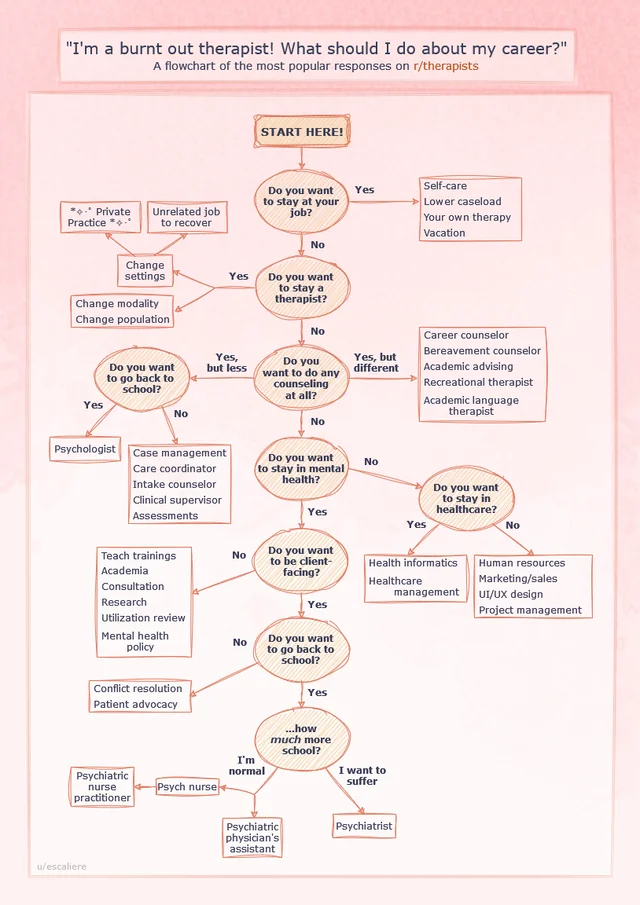
Source: u/escallere (Reddit Post)
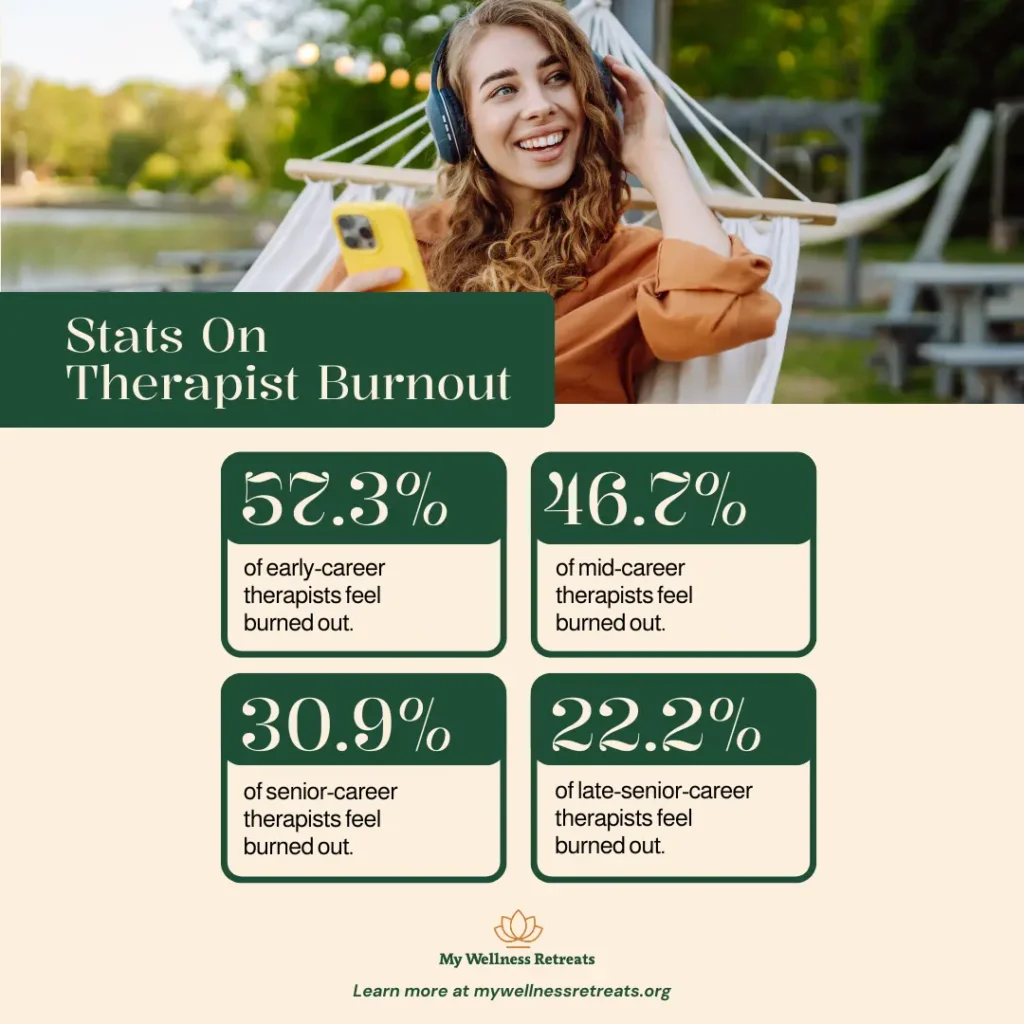
How bad is it? Well, according to the American Psychological Association, the earlier you are in your career, the more likely you are to experience full-blown burnout:
- Early Career Therapists: 57.3% feel burned out
- Mid-Career Therapists: 46.7% feel burned out
- Senior Career Therapists: 30.9% feel burned out
- Late Senior Career Therapists: 22.2% feel burned out
That’s not good.
Of those that are burned out, 73% say they are hesitant to take on tougher clients, and 60% say they struggle to strike a meaningful work-life balance—according to a 2023 SimplePractice survey.
Fortunately, you can spot the signs of therapist burnout before it gets out of control, as we’ll discuss in our next section:
5 Common Signs Of Therapist Burnout
Burnout doesn’t happen overnight. It stems from a pattern of workplace stress—especially when you consider the unique pressures on therapists, such as:
- vicarious trauma
- compassion fatigue
- administrative overload
Here are some of the warning signs to watch for before they spiral out of control:
1. You’re Questioning Your Competence As A Therapist (Or Your Career Path)
Take another look at that chart from Reddit. Notice anything interesting about it?
Most of it isn’t even about tackling burnout; it’s about navigating the job market away from your current role!
A major sign of burnout is wondering whether you’re even cut out for therapy, and it’s totally normal to ask yourself that.
But it doesn’t mean you need to give up entirely. You may find that once you have a clear solution to therapist burnout, you’ll feel renewed confidence and passion in your job.
2. You’re Dreading Upcoming Sessions
Look, our jobs aren’t easy. We’re called upon to be present, observant, grounded, and compassionate in every single session. That’s a big emotional lift—even on a good day.
But if you’re suddenly feeling a wave of dread before stepping into a room (or logging into Zoom) with a client, that’s a red flag. Dread can show up as procrastinating on session prep, fantasizing about canceling appointments, or feeling your stomach drop when you see your schedule.
As we might say in therapy: Notice the pattern, not the perfection. One hard day doesn’t mean you’re burned out. But when that anticipatory heaviness becomes a trend, it’s often your mind and body trying to tell you: “Hey… I’m at capacity.”
This doesn’t make you a bad therapist. It makes you human.
3. You Feel Emotionally Numb or Irritable
If you’ve noticed a recent change in your mood or emotional state, it could be burnout.
Sudden emotional shifts are one of the most common signals of burnout. Sometimes it looks like numbness, and it could feel like you’re disconnected from:
- clients
- work
- friends
- family
- hobbies
In other cases, you could be irritable. You might find yourself:
- snapping at small things (especially things that wouldn’t normally bother you, like a ticking clock or the rush of traffic outside your window).
- feeling easily frustrated—including with tiny problems or mundane tasks.
- feeling like you have a shorter fuse than usual.
Both numbness and irritability can stem from the same root issue: emotional overload without enough space to recover. When you spend your days absorbing the deepest pain of others, your own system may blunt or overreact as a survival mechanism.
4. Trouble Concentrating Or Being Present
As therapists, we often rely on attunement; tracking subtle shifts in tone, body language, and emotional energy is part of what makes therapy effective.
So when your concentration starts slipping—missing details, zoning out, rereading the same progress note three times—that’s another early warning sign.
Your cognitive resources are depleted. Emotional labor drains your attention just as much as your energy, and burnout often shows up first in the form of mental fog, distractibility, or struggling to stay fully present.
This is especially common after long stretches without breaks, supervision, or restorative downtime.
5. Increased Fatigue Or Illness
As Bessel van der Kolk wrote, the body keeps the score. Exhaustion, frequent headaches, muscle tension, disrupted sleep, or a sudden parade of colds and flu-like symptoms are all common physiological responses to chronic stress.
Burnout compromises your immune system, disrupts your nervous system regulation, and taxes your energy reserves. Even if you’re “resting,” you may not be recovering.
If you’re waking up tired, getting sick more often, or feeling like your tank is always running on fumes, that’s not normal—it’s burnout waving its arms in the air.
There’s scientific proof for it as well. One cross-sectional study found the inflammation and mental toll that comes with burnout negatively impacts the immune system, leaving you more likely to get sick.
5 Powerful Solutions to Therapist Burnout
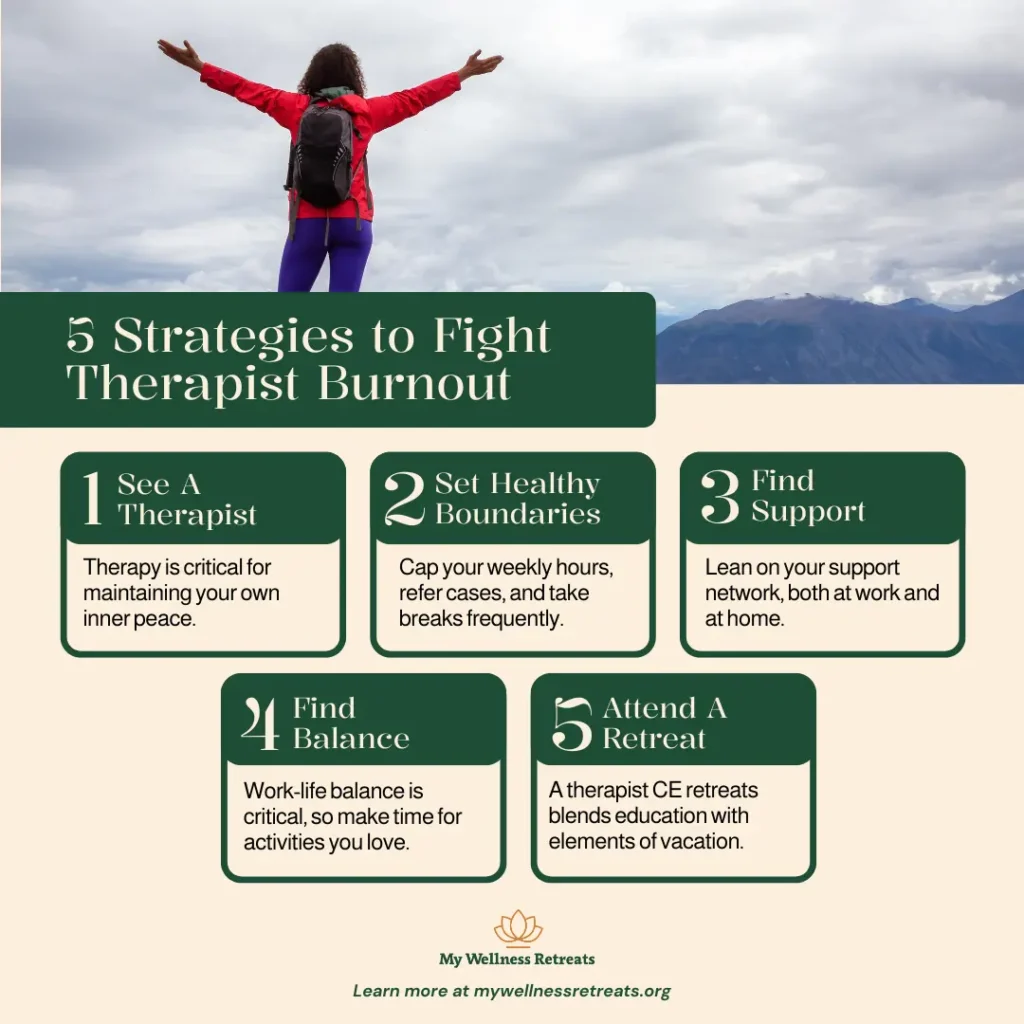
If you’re feeling the strain of therapist burnout, we have help. Here are five playbooks to follow to better mental health:
1. Find A Therapist
Therapy for therapists is sometimes labeled as taboo in the mental health space, but it’s a critical practice. After all, you’re recommending therapy for your patients. Shouldn’t you take some of your own medicine?
And attending therapy isn’t just good for you; it’s good for your patients, too. Research shows therapists deliver significantly better treatment to patients suffering from PTSD when these therapists aren’t burned out.
Ignore the stigma surrounding therapists in therapy. Give yourself the opportunity to heal.
And, trust us, we’ve heard every excuse:
- I’m too busy.
- There’s nothing someone can tell me that I don’t already know.
- I don’t want to work with someone in my region; it could damage my reputation.
- I don’t want my patients to find out I’m in therapy.
But for every excuse, there’s a rebuttal:
| The Excuse | The Rebuttal |
| I’m too busy. | Everyone is busy, but the people who know they need therapy make time for it. Many therapists offer weekend or evening hours as needed, so you can find a good therapist who fits your calendar. |
| There’s nothing someone can tell me that I don’t already know. | Therapy isn’t just about discovering truths about yourself. It’s also about unburdening yourself of the emotional weight you carry around on a daily basis. Plus, your therapist can help you tag team your burnout instead of leaving you to manage it on your own. |
| I don’t want to work with someone in my region; it could damage my reputation. | Online therapy is more popular than ever, and you can still access high-quality therapy from the comfort of your office or home. Related Reading: Is BetterHelp A Scam? |
| I don’t want my patients to find out I’m in therapy. | Your patients don’t need to know you’re in therapy if you don’t want them to know, but the public perception of therapy has never been more positive than it is right now. |
Tip: It’s never too late to start working on yourself! You can continuously become the best version of yourself with small, intentional efforts:
2. Set Healthier Boundaries With Your Caseload
Therapists are helpers by nature, which can make boundary-setting feel uncomfortable—abd even guilt-inducing. But taking on too many clients, too many crises, or too many emotionally demanding cases at once is a fast-track to burnout.
Here’s what setting healthy boundaries might look like:
- Capping your weekly client hours
- Scheduling breaks between sessions
- Reducing sliding-scale spots if your financial stress is adding pressure
- Referring out cases that consistently exceed your emotional bandwidth
Remember: Boundaries don’t limit your compassion—they protect it. When you set realistic limits, your clients get a grounded, present therapist instead of a depleted one.
3. Lean On Your Support System
Isolation is one of burnout’s biggest accelerators. Therapists often shoulder massive emotional weight without a support network that understands the field’s unique demands.
To help, lean on your support system. Some angles to consider:
- Vent during clinical supervision or on consultations with trusted peers.
- Rely on peer groups for case processing and emotional decompression.
- Join professional communities online or in person, whatever is best for you.
- Ask for help from friends and family to tackle your responsibilities around the house.
Humans aren’t meant to process life alone—especially when you’re encountering the trauma of dozens of clients a week. When you reconnect with supportive people and spaces, you create emotional padding that helps you absorb less of the stress and carry more of your own life.
4. Rebalance Your Workload With Restorative Activities
Burnout isn’t just about too much work—it’s also about not enough restoration. Rest is not the same as “doing nothing.” Rest is about activities that bring regulation back to your mind and body.
For some therapists, restoration looks like movement. That could mean:
- yoga
- walking
- hiking
- lifting
- dance
For others, it’s creative expression:
- journaling
- art
- music
- writing
Here’s how My Wellness Retreats speaker Andra Bruce, LCSW, puts it: “Creativity is a great way to reboot your energy! There are so many ways to create that there are options for everyone! I have recently been using art as a way to regulate emotions and have found it gives me an outlet for fun and stress reduction.”
And for many, it’s simple sensory soothing:
- warm baths
- tea rituals
- mindfulness
- time outside
The goal isn’t to create more obligations. It’s to carve out small, consistent moments that refill your emotional reserves. Think of it like regularly topping off your gas tank instead of waiting until the warning light comes on.
5. Attend A Therapist Burnout Retreat
At My Wellness Retreats, we’ve experienced the transformative power of therapist CE retreats firsthand. We know that regular self-care is essential for overall wellbeing—and for delivering greater care to patients.
But don’t take us at face value. Here are four more mental-health-boosting reasons to attend a therapist retreat:
- It’s an opportunity to focus on you. This is your chance to escape from your schedule in the office to dedicate time to your physical, mental, and emotional health.
- Enjoy nutritious meals, restorative sleep, and peaceful environments. Forget about convenient gas station snacks in between sessions and staying up late to file paperwork. A retreat is your time to focus on health.
- Deepen your appreciation for your vocation while simultaneously deepening your skillset. Reignite that flame inside you—the one that originally inspired you to become a therapist.
- Connect with others. Meet fellow therapists from all around the world—many of whom are facing the same professional challenges you are. Swap tips, learn from each other, and build long-lasting professional relationships.
Plus, our therapist CE retreats frequently include physical wellness elements—which research shows can boost positive outcomes by 20%. Talk about a value booster!
Don’t let another therapist retreat pass by. Sign up for our newsletter to keep up with our schedule!
How to Prevent Therapist Burnout In the Future
Keep burnout at bay by remaining proactive in your mental health care. Scheduling regular therapy sessions can help, but so can having something to look forward to.
Book a rejuvenating therapist retreat to keep yourself feeling inspired in the months ahead—and to give yourself an opportunity to recharge while connecting with other busy professionals who are just as passionate about their work as you are!
Frequently Asked Questions
What is therapist burnout?
Therapist burnout may appear in a few different ways. Some of the most common signs include:
- You’re questioning your competence.
- You’re dreading upcoming sessions.
- You’re irritable or emotionally numb.
- You have trouble concentrating.
- You feel unusually fatigued.
How can I avoid burnout as a therapist?
Every therapist is different when it comes to self-care, but here are five powerful solutions that may work for you: therapy, professional boundaries, support systems, restorative activities, and multi-day therapist retreats.
What causes therapist burnout?
In addition to working long hours with a significant workload, many therapists eventually grow overwhelmed by vicarious trauma, compassion fatigue, and administrative overload. When combined with a lack of self-care, these factors can quickly lead to burnout.
Can therapist burnout impact the quality of care I provide?
Yes, and research strongly supports this. Burnout can impair empathy, decrease attentiveness, and reduce clinical effectiveness—which is why it’s so important to address early warning signs. When you’re emotionally and mentally restored, your clinical intuition, presence, and decision‑making improve significantly. Taking care of yourself is just as important as taking care of your clients.
How long does it take to recover from therapist burnout?
There’s no one‑size‑fits‑all timeline, and recovery depends on factors like severity, support systems, workload, and personal coping strategies. Some therapists feel relief after a few intentional changes—such as reducing caseload or attending a retreat—while others need weeks or months of systemic adjustments and therapy. The key is consistency: small, sustainable shifts often lead to long‑term healing and resilience.
About the Author: Tomilyn Ward, LPC, MPC, NCC
Tomilyn Ward, LPC, MPC, NCC is a trauma-informed therapist and the founder of My Wellness Retreats; My Wellness Center, a mental health practice based in Allison Park, PA, just outside of Pittsburgh; and the MAYA Organization, a nonprofit assisting low-income pregnant women in need of guidance. She’s also a birth doula who has assisted in more than 30 births. A lifelong learner, Tomilyn regularly takes three times the required number of CEU credits every year.
2 Responses