What It’s Like to Be A Therapist In 2026 (And Predictions for 2027)
When I started my therapist journey nearly a decade ago, the entire world looked different.
This was pre-pandemic and shortly after the 2016 presidential election. At the time, the country was thrust into headlines of police brutality and demonstrations, and many were worried about the direction Trump’s first term was taking the country.
Looking back, that time period almost seems idyllic. As chaotic and terrifying as it was, many of my newest clients today are struggling worse than my first clients so many years ago.
Society has only become more complicated, and that’s made being a therapist even more difficult.
Table of Contents
The Challenges of Being A Therapist In 2026
Predictions for 2027 (And Beyond)
Find Support For Therapists: Book A Therapist Retreat
The Challenges of Being A Therapist In 2026
Here’s where I’m seeing some of the biggest trends in my own practice this year:
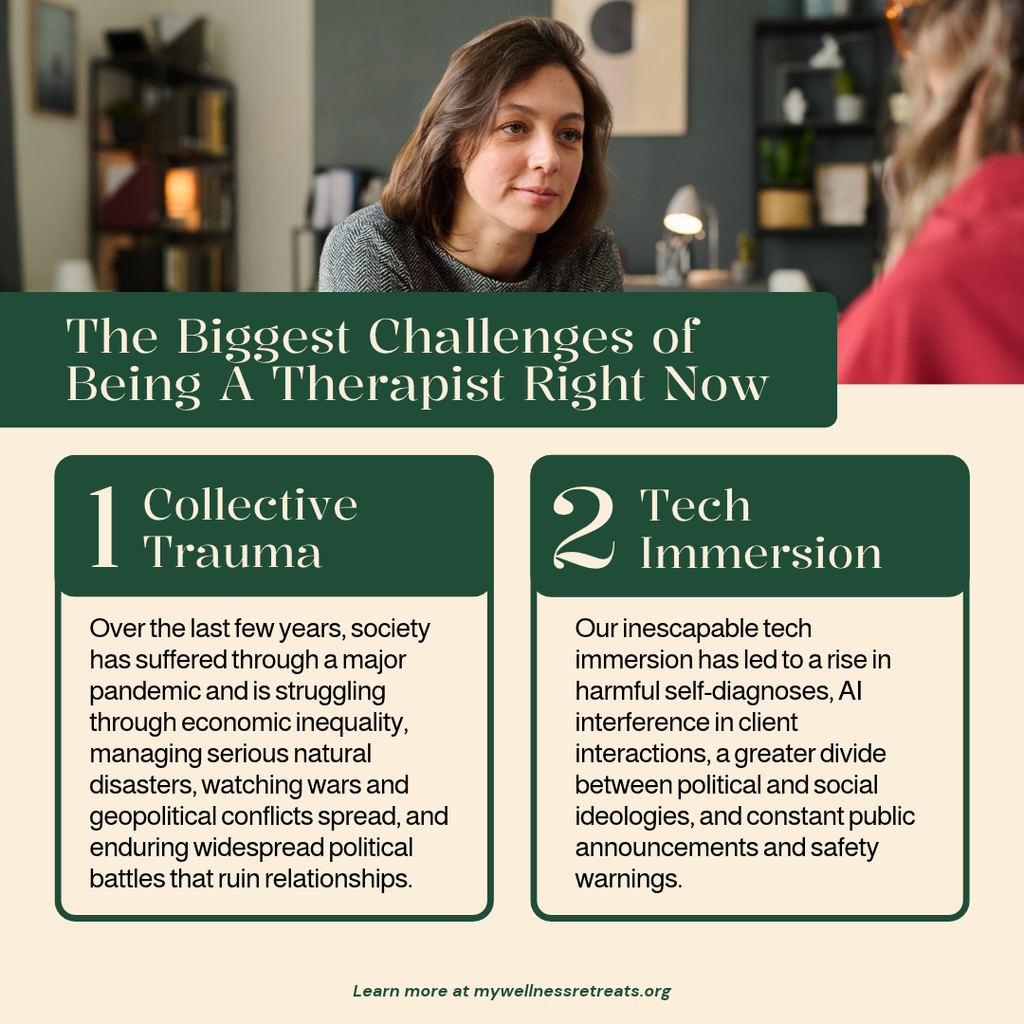
1. There’s More Collective Trauma
Collective traumas have permeated our contemporary culture, and that’s had a direct influence on therapy sessions, especially since the COVID pandemic.
Think about it: For people who were born post-9/11, it’s difficult to remember a time when there wasn’t a constant threat of terrorism or conflict in the Middle East.
More recently, we’ve seen:
- Mass deaths through the pandemic. As we mentioned above, COVID ripped through the entire world, and that created a renewed sense of isolation while many families encountered abuse, loss, and trauma.
- Economic strife. Today’s society has barrelled toward an all-time wealth disparity, as the wealthiest 1% of Americans hold the same amount of wealth as the bottom 90%. And as gas prices reach record levels and grocery bills spin out of control, many Americans are struggling, more than ever, to make ends meet. Families are forgoing vacations, avoiding college degrees, delaying having kids, and struggling to buy their first homes.
- Community trauma. Many in Pittsburgh still remember the Tree of Life assault—an attack that ripped through our community and left many feeling fragile, afraid, and at-risk. Similar horrors reach the headlines every day, from the Lindsay Clancy trial to the recent family murder in Erie, PA.
- Natural disasters. Scientists have warned us for years that natural disasters would become more dangerous and more frequent, and that seems to be true. And it’s not just Katrina-level events that destroy lives and communities. As we’ll discuss in a moment, even hyper-local flooding can kill residents and traumatize families and larger communities.
- Wars and geopolitical conflict. It’s difficult to avoid the heartbreaking headlines about the war in Ukraine or the war in Gaza. Even more destructive: These geopolitical conflicts have torn families and friends apart in the United States, as many of these issues touch on the heart of political issues.
- Political conflict. We’ve never had a more divided nation, and more and more I’m seeing clients complaining of political differences between family and friends—especially since the Clinton-Trump election. The political divide has destroyed relationships, and that’s led to more conversations in therapy sessions.
2. There’s Greater Tech Immersion & Challenges
Technology advancements of the last decade or two have generated both positive and negative impacts on therapy sessions and overall mental health.
What to be aware of:
Pros of Tech
The biggest benefit of technology: therapy accessibility. Thanks to telehealth, people all over the world can access high-quality therapy sessions.
That’s true for our therapists at My Wellness Center, too. We can work with clients all over Pennsylvania and other states. Even though our physical office is in Allison Park (just north of Pittsburgh), we have an impact well beyond our neighborhood.
Cons of Tech
Unfortunately, tech advancements have created significant headaches for therapists, including:
1. Increased Self-Diagnoses – Clients have more access to information than ever before. And while that’s led to greater awareness of common psychological disorders, it’s also led to a higher rate of self-diagnoses.
That’s incredibly dangerous. This sort of misinformation can lead to improper treatment methods and potentially cause additional harm.
Diagnoses should only be made by qualified professionals.
2. AI Has Disrupted Client Interactions – We’ve seen this in two different, frustrating capacities:
- Clients are using AI as a therapy tool. Tech-savvy individuals are turning to AI for mental health support, and the numbers are alarming. Seventy-seven percent of psychologists say their patients use AI (often for mental health), and 49% of regular AI users with mental health conditions also use AI for mental health support. Unfortunately, there’s no oversight or supervision here; no one is confirming whether or not AI is doing a good job—and that’s not even bringing up the times AI has told people to kill themselves.
- Tech companies are trying to force AI into meetings. Another frustration: Some therapy tech tools want to bring AI into client sessions—especially to record and transcribe meetings. While the intentions here are allegedly altruistic, there’s an obvious risk of violating HIPAA and other privacy issues. My personal belief: Therapy should be a private conversation between you and your therapist.
3. Greater Divide in Society – As we mentioned earlier, society seems more fractured than ever, and the research backs that up.
A 2026 poll by the Pew Research Center found the majority of social media users believe these platforms are harmful to democracy.
Additional research shows social media is “implicated in the rise of polarisation, intergroup conflict and extremist movements.”
4. Public Announcements Increase Anxiety – Back in 2018, an erroneous missile alert terrified Hawaiians who believed their deaths were imminent. Fortunately, the cell phone alert was a mistake, and no missile crisis was inbound.
But the fear and trauma ripped through the islands, and many were rightfully outraged.
Nearly 5,000 miles away, we’ve seen similar (though certainly less terrifying) issues in Pittsburgh.
For example: Our region of Pittsburgh’s North Hills is known for occasional flooding, and the heavy rains and winds of 2026 have led to property damage, car accidents, and more.
And after the last intense storm, authorities have become more cautious. They send alerts every time there’s a storm.
In other words, every time there’s heavy rain, everyone receives a text telling them to stay in place and use caution.
Although this is well-intentioned, the texts often backfire; they may actually increase fear and anxiety beyond what’s appropriate for the current weather conditions.
And that can have negative long-term effects.
Predictions for 2027 (And Beyond)
Sadly, I think many of these issues will only grow worse before they get better. A few thoughts on what’s ahead:
- Technology: At the moment, it doesn’t seem like there’s any chance of slowing AI or social media—at least not in the United States.
- Political Turmoil: And the political turmoil that’s tearing families apart? It looks like that’s going to continue, too, especially with the current administration in power.
- Geopolitical Issues: Geopolitical issues like the war in Ukraine seem like they could continue to drag on indefinitely.
- Environmental Problems: Environmentalists have made strides in trying to protect the Earth, but government officials continue to threaten national parks, remove barriers to data centers, and expand drilling activities that could harm the planet.
It all looks so bleak.
But that doesn’t mean we have to accept it as such.
I still love being a therapist.
And you can, too.
As I mention in How to Manage Stress Like A Therapist, people look to us for guidance.
And if we can protect our own mental health, we can prevent burnout and continue helping the people around us.
Find Support For Therapists: Book A Therapist Retreat
Therapist retreats are my favorite strategy for therapist self-care.
They give me an opportunity to escape the stressors of the office while connecting with fellow professionals and working on therapist professional development.
Book a retreat to rekindle your love for the therapy profession and earn CEs at the same time!